
Menu closed
Repetitive training in hockey is deliberate, structured practice that repeats specific movement patterns until execution becomes automatic, and it directly builds muscle memory, strengthens the brain-body connection, and increases composure under pressure. In this article you will learn why repetition matters for stickhandling and shooting, which neural mechanisms drive faster execution, and how to design practice plans that transfer off-ice work to on-ice performance.
Many players struggle to convert effort into consistent game-time execution; targeted repetition solves that by turning fragile, attention-demanding skills into reliable motor programs. I will map the neuroscience (myelination and procedural memory), provide drill-level instruction for stickhandling and shooting, show cognitive and pressure-simulation drills to preserve composure, and compare modern tech options like virtual reality and cognitive trackers.
Read on for practical templates, EAV tables that summarize repetition parameters, and stepwise practice plans you can adapt to age and skill level.
Repetitive training is the process of intentionally repeating discrete motor patterns so the nervous system encodes them as procedural memory, which reduces conscious control and increases speed and consistency. Mechanistically, repetition strengthens synaptic connections and promotes myelin formation around frequently used neural pathways, which accelerates signal conduction and lowers error rates during fast actions. The practical benefit for hockey players is straightforward: skills practiced deliberately become reliable under time pressure, enabling faster decisions and cleaner technical execution. Understanding these mechanisms helps coaches prioritize focused reps over random, unfocused activity, and sets the stage for drill selection and progression that follow.
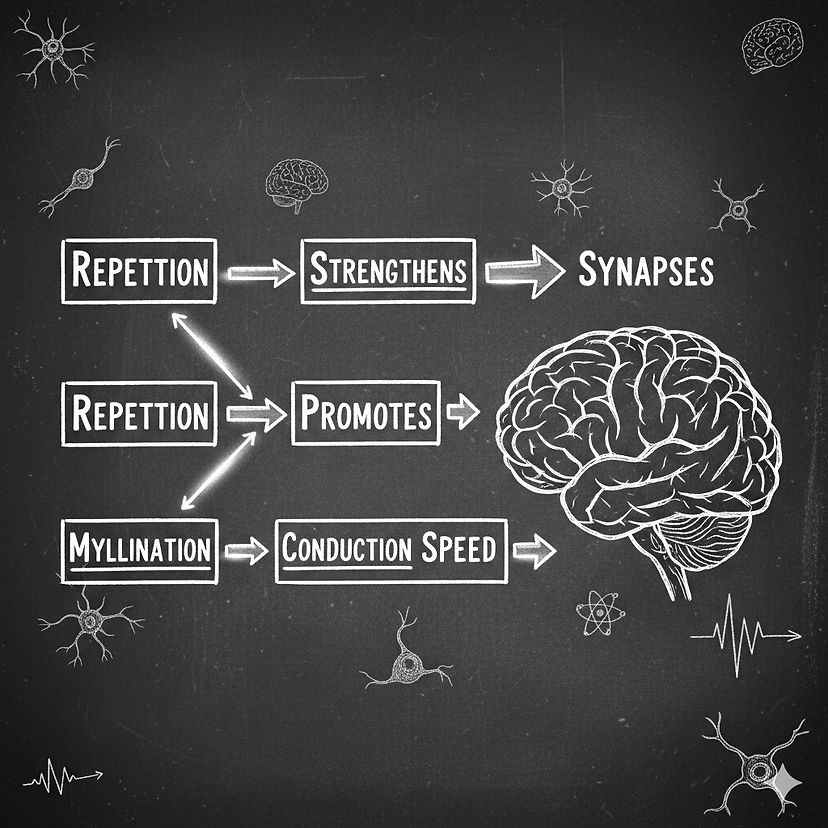
Repetitive training delivers three primary performance benefits for hockey:
Improved technical consistency through muscle memory and reduced variance in execution.
Faster reaction and decision times via improved brain-body coupling and conduction speed.
Greater composure under pressure as automatic skills free cognitive bandwidth for game-situation choices.
These benefits form the rationale for specific drill prescriptions and training progressions described next.
Muscle memory refers to procedural memory systems in the brain and spinal cord that encode motor sequences through repeated activation; repetition modifies synaptic strength and encourages myelination, which I describe as building "neural highways" for a movement. In practice, repeated stickhandling or shooting actions send the same neural pattern over time, and the nervous system optimizes that pattern for speed and reliability.
Recent studies and coaching observations show that frequency, focused attention, and consistent mechanics accelerate consolidation, with shorter daily sessions often outperforming rare, long sessions because sleep and consolidation between sessions reinforce learning.
Research indicates that motor skill learning directly impacts white matter structure, leading to enhanced neural pathway efficiency.
Article: https://pubmed.ncbi.nlm.nih.gov/24336716/
A practical takeaway is that deliberate repetition, defined reps with specific mechanics and measurement, beats unfocused volume; coaches should prescribe tempo, target outcomes, and progression so the neural encoding is both specific and transferable to game contexts. This leads directly to how automaticity improves split-second reactions on ice.
When technical skills are encoded as automatic routines, the cognitive load to perform them drops significantly and decision-making speed increases because pre-wired responses can be executed with minimal conscious intervention. Automaticity is not mindless; it is efficient: the player’s sensorimotor loop recognizes cues and triggers practiced motor programs, which reduces reaction time for plays like one-touch passes or instant dekes. Practice that pairs stimulus identification (visual or auditory cue) with immediate motor response, repeated at game-like tempos, bridges perception and action so the body acts before conscious deliberation slows the response.
To preserve automaticity under stress, drills should progressively introduce pressure, decision variety, and fatigue to ensure the automated response remains robust; the next section shows how that muscle memory applies to specific hockey skills like stickhandling and shooting.
Muscle memory improves stickhandling and shooting by encoding exact movement patterns, hand positions, wrist snap, weight transfer, so that accuracy, tempo, and release timing become consistent even under defensive pressure. For stickhandling, procedural encoding reduces puck-losing errors and improves control at game speeds; for shooting, encoded mechanics shorten time-to-release and improve target accuracy. Coaches can measure transfer by tracking metrics such as puck-touch variability, time-to-release, and shot-on-goal percentage; those metrics respond predictably to structured repetition.
Below is a concise comparison of technical skills showing mechanics, repetition parameters, and transfer indicators to help coaches prioritize sessions.
Different technical skills require tailored repetition parameters and measurable transfer indicators.
This table helps coaches allocate time and monitor transfer by linking mechanics to repetition density and observable outcomes. Next, practical drill menus show how to put those parameters into action for stickhandling and shooting.
Effective stickhandling repetition focuses on controlled touches, tempo variation, and weak-hand emphasis to build bilateral proficiency and automatic control. Start with stationary puck-control sequences: 100 single-hand touches on each side with strict mechanics, then progress to cone slaloms with tempo shifts and finally add movement and decision layers.
A sample drill progression: stationary touch set → cone slalom at moderate speed → weak-hand only set → moving slalom with passive defender; measure successful completions and touches-per-second as outcomes.
Stationary puck control: 5 sets of 20 touches each hand, focus on wrist angle.
Cone slalom: 4 reps down-and-back, vary tempo every rep.
Weak-hand repetition: 3 sets of 30 seconds dedicated to non-dominant hand.
These drills prioritize deliberate practice with objective metrics; consistent use of these progressions promotes transfer into on-ice possession and deke scenarios.
Repetitive shooting drills isolate release mechanics and target precision to shorten time-to-release while preserving aim; the idea is to rehearse a consistent movement under varying conditions. Begin with rapid-fire stationary shots on a target to engrain wrist and snap mechanics, then add movement and angle-specific repetitions to simulate game positions. Example drill progression: 10 rapid shots from slot focusing on identical setup → angled-release reps from both wings → on-the-move snapshot sets, each tracked for hit rate and average release time.
Rapid-fire target reps: 5 sets of 10 with 15–20 seconds rest, track hits.
Angle-specific repetition: 4 zones, 15 reps per zone, focus on body alignment.
On-the-move release: 3 sets of 8 sequences, focus on weight transfer.
Track shooting percentage on target and average release time to quantify improvement and guide incremental load increases in subsequent sessions.
Repetitive training strengthens the brain-body connection by refining sensorimotor integration, linking visual and proprioceptive input to precise motor outputs, so actions become faster and more accurate. Neural plasticity supports this refinement: repetition sharpens synaptic pathways and augments myelination, which improves conduction velocity and movement smoothness. Practically, players experience this as reduced hesitation, cleaner edgework, and more precise puck manipulation at speed. Understanding these mechanisms suggests pairing cognitive layers with motor repetition to amplify transfer.
Below are cognitive and coordination drill categories that pair perception with movement to strengthen sensorimotor links.
Visual tracking and decision drills that require quick gaze shifts and immediate motor responses.
Dual-task exercises combining ball/ puck manipulation with counting or pattern recognition.
Reaction ladder or light-based drills that force immediate motor adjustments under unpredictable cues.
Each drill type increases brain-body fidelity by integrating stimulus recognition and practiced motor response; the next subsection outlines the neural mechanisms behind measurable execution improvements.
Faster execution on ice comes from synaptic strengthening and increased conduction speed due to myelination along repeatedly used circuits, which reduces transmission delay and smooths motor commands. Sleep and inter-session consolidation are essential because they stabilize and sometimes amplify the synaptic changes initiated during practice; repeated short sessions with recovery often produce faster durable gains than infrequent long sessions. Markers of neural change appear behaviorally as reduced variability, quicker initiation times, and improved coordination under pressure; coaches should expect measurable changes over weeks to months depending on repetition density.
The process of motor learning is intrinsically linked to adaptive myelination, which plays a crucial role in enhancing neural signal transmission speed and efficiency.
Article: https://pmc.ncbi.nlm.nih.gov/articles/PMC9158406/
These neural changes explain why adding cognitive load to physical repetition improves transfer, which leads to specific cognitive-coordination drills described next.
Cognitive and coordination drills pair perceptual tasks with motor repetition to make neural circuits both fast and contextually flexible. Examples include visual tracking drills where the player follows moving targets and immediately performs a practiced motor response, light-based reaction sequences that require instant edge adjustments, and dual-task sets that combine decision-making with quick puck manipulation. Each drill should be measured for reaction time, successful execution rate, and decision accuracy to track progress.
Visual tracking with immediate execution: follow target then execute pre-set skill.
Reaction-light edge drills: respond to lights with directional pushes.
Dual-task handling: perform puck moves while verbalizing patterns.
Integrating these drills into skill blocks increases the fidelity of practice-to-game transfer and prepares players for real-game perceptual demands.
Repetitive training builds composure and mental toughness by creating automatic responses to high-pressure triggers so that cognitive resources free up for higher-level decision-making and situational awareness. As technical fundamentals become automatic, players experience less performance anxiety in split-second scenarios because practiced responses diminish the need for conscious correction. Rehearsing skills under stress, time constraints, crowd noise simulations, or score pressure, ensures that automaticity remains stable when stakes rise, which is essential for consistent game performance.
Below are pressure-simulation drill types that incrementally increase stress while demanding automatic technical execution.
Timed possession sequences with decreasing allowed time.
Short-shift high-intensity repetitions with immediate decision requirements.
Controlled scrimmage scenarios with imposed score/time constraints.
These progressions help players habituate to pressure and preserve technical quality when it matters most.
Automaticity reduces pressure by lowering the cognitive load required for basic skills, freeing working memory for strategic choices and threat assessment; in effect, practiced motor programs run in the background so the player can assess and select higher-level tactics. This cognitive unloading improves situational awareness because fewer resources are consumed by execution concerns, which speeds up quality decision-making during transitions and chaotic plays.
Coaches should explicitly rehearse decision hierarchies, recognize cue, select practiced response, execute, so automaticity supports, not replaces, game intelligence.
Practicing scenario templates until responses feel routine builds the psychological habit of calm execution, which we reinforce further with targeted pressure drills next.
Effective composure drills simulate game stressors while insisting on technical fidelity so mental toughness grows alongside skill automaticity. Start with timed possession challenges that reduce allowable decision time each round, then progress to short-shift repeats that induce fatigue and require immediate correct choices, and finish with controlled scrimmages that add crowd or coach-generated noise to mimic distraction.
Each drill should have clear success metrics, completion percentage, error rates under constraints, and decision time, to quantify composure improvements.
Timed possession under pressure: progressively shorten time windows for completing plays.
Fatigue-loaded decision reps: perform short high-intensity shifts then execute a skill sequence.
Controlled chaotic scrimmage: add noise or constraints that force rapid decisions.
These drills train players to perform practiced motor programs under realistic stress, reinforcing composure and decision quality for games.
Implementing effective repetitive routines requires structure: a purposeful warm-up, focused skill blocks with defined reps and progressions, situational scrimmage to force transfer, and recovery for consolidation. Weekly templates balance frequency and intensity so motor learning consolidates without overloading tissue or attention systems. Measurement, simple metrics like reps completed, accuracy rates, and reaction time, drives feedback loops that inform progression and coaching cues. Below I provide stepwise steps to build a practice plan and an EAV-style table that outlines session components and their purpose.
A practical, repeatable practice plan follows a predictable template that can be scaled for age and skill.
This practice-plan table provides a clear structure; following it consistently enables efficient motor learning and measurable transfer to game performance.
Practical recommendations for locating guided repetition include seeking structured coaching environments, skill camps, specialized coaches, or guided practice programs, that emphasize deliberate practice and measurement rather than unfocused volume. When selecting externally guided options, prioritize programs that prescribe repetition parameters, provide timely feedback, and include progress metrics so practice quality is preserved across sessions. These neutral criteria help players and parents evaluate options without relying on brand-specific claims or unsupported promises.
A structured practice plan breaks a session into purposeful phases and prescribes rep targets, rest, and feedback so each rep serves learning. The warm-up primes coordination and mobility, the skill block concentrates high-quality reps with specific mechanical cues, the integration phase tests transfer under decision pressure, and the cooldown captures metrics and reflections. Repetition guidance should specify sets, reps, tempo, and rest intervals: e.g., 5 sets of 20 controlled touches with 45 seconds rest, to ensure intensity and specificity align with learning objectives. Video or coach feedback completes the loop by highlighting consistent errors and tracking improvement over weeks.
These components create a repeatable learning environment that speeds procedural encoding and supports continuous progression to higher-fidelity game situations.
Off-ice repetition complements on-ice training by isolating hand speed, shooting mechanics, and coordination in low-risk, high-density practice environments that still map to hockey-specific motor patterns. Drills like ball-handling routines, resistance-band shooting mechanics, and reaction-light footwork increase neuromuscular speed and pattern specificity. Recommended frequency is 3–4 short off-ice sessions per week that focus on targeted elements rather than full practice replication, with clear transfer checks on ice such as touch variability and release time. Monitoring on-ice performance after off-ice cycles helps validate transfer and adjust off-ice emphasis.
When off-ice drills are paired with on-ice repetition and consistent measurement, they accelerate skill consolidation and provide additional rep volume without increasing on-ice fatigue.
Modern technologies augment repetitive training by increasing decision density, measuring reaction time, and providing precise feedback that accelerates neural encoding and technical refinement. Virtual reality platforms simulate game scenarios at high density, cognitive trackers improve perceptual processing and sustained attention, and video-analysis plus wearables provide objective metrics for each repetition. The best approach is a hybrid: use tech to enhance repetition fidelity and decision rehearsal, but maintain physical on-ice and off-ice reps for motor pattern specificity. Below is an EAV-style comparison of common tech categories and the measurable benefits they provide.
Technology tools differ by mechanism and measurable outcome; coaches should choose tools that align with training goals.
This comparison clarifies how different tools complement deliberate repetition; next we explore how to integrate these options practically and when to favor traditional repetition.
Virtual reality supports repetition by increasing the density of decision-making opportunities without the physical constraints of on-ice sessions, enabling players to rehearse reads, passing lanes, and situational choices at scale. VR excels in perceptual training recognizing patterns and rehearsing appropriate motor plans, though it is limited in direct physical skill transfer because it cannot fully reproduce skating forces and puck dynamics. Practical implementation: short VR sessions 2–3 times per week focused on decision scenarios, paired with on-ice reps that enforce physical mechanics. VR therefore complements rather than replaces physica
l repetition, accelerating the cognitive side of skill acquisition.
When used this way, VR increases the mental rehearsal volume and reinforces the sensorimotor links that on-ice repetition then converts into durable motor skills.

Cognitive tools like multi-object tracking exercises, reaction-light systems, and simulator-based perceptual training improve reaction time and visual-motor coupling when paired with motor repetition. These tools force rapid information uptake and immediate motor responses, which mirrors game demands and increases the speed of the brain-body loop. Integration protocols pair short cognitive sessions before or after skill blocks, or embed cognitive load within technical reps to increase fidelity. Outcomes to track include reaction time reductions, decision accuracy, and sustained attention scores, all of which predict improved in-game responsiveness.
Used alongside measured physical repetition, cognitive tools raise the ceiling of automatic responses and sharpen the brain-body connection necessary for elite-level execution.
Puck control skills training for players ages 6–11 in small groups of up to 9 skaters. Sessions focus on stickhandling fundamentals, puck protection, passing accuracy, and developing the hands every young player needs to advance. Coaching is patient and progressive — players learn by doing, with high reps in tight spaces on real Las Vegas ice.
Full-week hockey development camp with 2 hours on-ice daily, guest appearance by Swaggy P. Limited
Elevate your game with ULTIMATE POWER SKATING at ELEV802! Our specialized session focuses on developing advanced skating techniques, enhancing speed, agility, and power on the ice. Unlock your full potential in a supportive, high-energy environment tailored for players of all ages and skill levels.